Is hybrid additive manufacturing future of additive manufacturing?
Is Hybrid Additive Manufacturing
future of Additive Manufacturing?

Global 3D printing market value, 2013-2020 ($ million)
(Fig 01)
“The
future is in 3D printing.”
~ Unknown
As Fig 01, the graph
displays the magnitude of the global market for 3D printing from 2013 to 2020.
The market for 3D printing is anticipated to reach 200 million US dollars
worldwide in 2021, according to the sources. So, do you all really think that
the future will end up on 3D printing only? The question arises that will the
3D printing rule the manufacturing and industrial sectors in coming time? The
answer can be yes or no. Let’s move to
it.
What is 3D printing/
additive manufacturing?
Rapid
prototyping and material deposition techniques are used in 3D printing, also
known as additive manufacturing or rapid prototyping, to build objects layer by
layer. As opposed to more conventional (subtractive) production, when material
is taken out of a solid block until only the final part is left, additive
manufacturing refers to the successive addition of materials. Turning and
lathing, CNC, or common cutting techniques like laser, water jet, and machine
cutting are examples of subtractive production.
There
is a huge difference between additive and subtractive manufacturing.
What
is subtractive manufacturing?
A
material removal process known as subtractive manufacturing usually begins with
solid plastics, metal or other material block, bars, or rods that are molded by
removing material through cutting, boring drilling, and grinding.

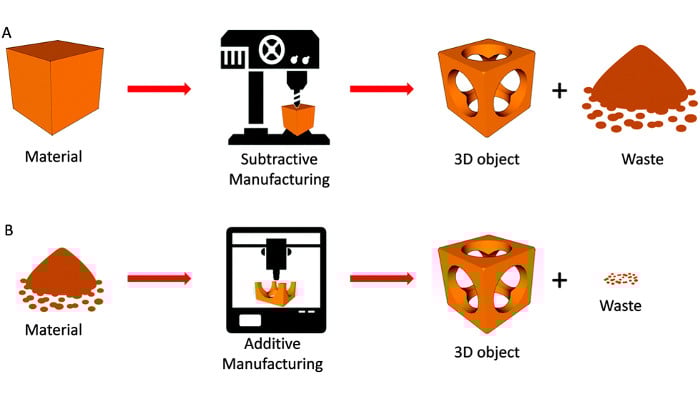
Difference
between additive and subtractive manufacturing
Fig
02
Above
image (Fig 02) describes the difference between additive and subtractive
manufacturing as A parts shows the process of subtractive manufacturing,
basically in subtractive manufacturing, production takes place by cutting the
object as raw material and shaping that object in desired way. This leads to
wastage of material in huge amount.
B
part shows the process of additive manufacturing, basically in additive
manufacturing there is no wastage of materials and manufacturing takes place by
developing layers. This manufacturing works no layer-by-layer process.
Basically,
both additive and subtractive manufacturing have some complexity while
manufacturing products.
To avoid complexity and errors, additive hybrid
manufacturing has been introduced in industrial and manufacturing sectors. The introduction
of additive hybrid manufacturing made it easy for industrial sector to
manufacture products with effective result and less errors. Hybrid
manufacturing is slowly replacing additive and subtractive manufacturing
worldwide as it consumes less period of time. Since hybrid additive
manufacturing combines both additive and subtractive manufacturing, it
addresses the shortcomings of additive manufacturing. It is possible to 3D
print and finish a product in one configuration when additive manufacturing
collaborates with CNC milling: The printed part doesn’t need to leave the build
envelope to be reset on a different machine, which lowers errors. Combining
additive manufacturing (AM) and subtractive manufacturing (SM) on the same
machine is referred t as hybrid manufacturing. Although each process has
exceptional capabilities on its own, when used in combination, a whole new
level of design and manufacturing is possible.
Utilizing
sequential additive and subtractive processes is one of the most popular hybrid
manufacturing techniques. To replace a traditional casting or forging, for
instance, the machine might 3D print a component with a close to-net shape. It
might then be finished by using its subtractive capabilities.
This
manufacturing consists of addition features which allows it to work
productively and gives effective results.

Additive Manufacturing + Subtractive
Manufacturing = Hybrid additive manufacturing
(Fig 03)
Fig 03 represents the
combination of additive and subtractive manufacturing in a single machine. This
defines hybrid additive manufacturing in a very fine way.
Characteristic features of Additive hybrid manufacturing:
Cost effective –This production is affordable and efficient. Because it effectively consumes all the basic materials. It produces good results with no material wastage. The goal of a hybrid manufacturing system is cost reduction by combining the additive manufacturing principle of tool-less production with traditional subtractive manufacturing for production with traditional subtractive manufacturing for product finishing or post- processing.
· Surface finish- As additive hybrid manufacturing combines additive and subtractive manufacturing; it takes hybrid approach to both of these techniques. Additive manufacturing can produce raw parts with nearly net shape geometrical and dimensional characteristics, while subtractive machining operations can be used to refine these raw parts to achieve the desired dimensional accuracy and surface finish.
· Consuming Alloy- Due to concern with surface roughness, supports structure removal, insufficient built rate, a constrained maximum build size, and other factors, mass additive manufacturing of metals and alloys are currently difficult. Making alloys without wasting resources is now simple, because of introduction of hybrid production. Any metal that is obtainable in wire or powder from might potentially be 3D printed, depending on the system. These materials include, among others, titanium, cobalt chrome, copper, Inconel Stainless steel, and tool steel. One benefit of hybrid metal systems is that they frequently allow the application of several metals to the smart part, such as using Inconel for strength or copper for heat transfer.
· High accuracy and precision – Hybrid manufacturing avoids error and gives the desired result with accuracy. No layer formation is needed in this process. The product formed as result have high precision value. All the needed work is done by the single machine so there are less chances of getting errors.
· Good over-molder – It reduces the steps involved in manufacturing process. As it applies additive and subtractive manufacturing in sequence it saves the time of manufacturing. Basically, if we first go for additive manufacturing and then for subtractive one, it will consume time in the production because different machines are working in process.
Application of hybrid manufacturing; -
· Electric vehicle industry- As hybrid additive manufacturing is developing and supplanting additive manufacturing in industrial sectors. As it is intuitive and cost effective it leads the sustainability. To manufacture commercial parts and prototypes. With the use of this technology, complex geometries could be made into lighter, stringer pieces. Considering the number of components in a vehicle, even a little reduction in tooling costs has a significant effect on the overall cost of ownership, which affects both the producer and the buyer. Due to hybrid manufacturing designers are able to build casings with thinner walls into complicated, stackable designs, which can help when it comes to maximizing battery space. Due to hybrid manufacturing, it produces dynamic components, reduce weight, and maximize battery life. As this process deals with less tooling, the lack of tooling makes it much simpler and less expensive to update designs and offer customization possibilities. Customers can quickly modify anything from emblems to brackets using hybrid manufacturing without noticeably increasing cost or production times.
·
Aerospace: - Metal hybrid additive manufacturing makes
it possible to produce intricate goods and parts with less waste. MHAM has a
wide range of uses, such as in prototyping, tooling, and end-use components. Due
to their excellent strength-to-weight and stiffness-to-weight ratios,
high-strength Al alloys are frequently utilized to make structural components
in the aerospace sector. They are also easy to machine. Many aerospace
components have complex geometries, which can make fabrication difficult when
using conventional subtractive manufacturing techniques. So, to manufacture
light weight parts hybrid manufacturing is used.
· Medical Devices: - Medical devices like implants and prothesis are also being made using metal hybrid additive manufacturing. Custom-fit devices can be produced using this technology, which reduces the risk of problems. Beginning with imaging or capturing the patient’s geometry using computer tomography or another 3D scanning technique is a standard approach for tailored medical equipment. Still hybrid additive manufacturing is progressing in the medical field.
· Military and defense equipment: - As hybrid manufacturing gives possibility of cladding and/or adding materials to pieces, and performing dimensional restoration either at the conclusion of the procedure or periodically as the material addition process goes on. It adds even more detailed sets of rules and restrictions when used in military applications. Prototypes can be made using this procedure, as well as replacement or original parts.
Conclusion-
If we put a light on the topic, “Is
Hybrid Additive manufacturing the future of additive manufacturing?” after
focusing on the pros of hybrid manufacturing then answer is “Yes, it can be”
because it is making manufacturing process easier with less efforts and period
of time. It gives better outputs and minimum wastage of raw materials. The manufacturing
sectors are now developing a Hybrid Additive Manufacturing (HAM) technique to
reduce manufacturing costs while improving the mechanical property and surface
quality of the product. In contrast to using a single production technique, HAM
combines additive manufacturing with a traditional manufacturing process to
provide benefits of two functions in a single machine. The most advantageous aspects of both
technologies are combined in hybrid manufacturing: the high precision of
subtractive processes and the geometric complexity of additive manufacturing.
This implies that a part can be additively manufactured and machined in a single
step, speeding up the manufacturing process. Clearly, this means that the
design of any hybrid component must take into account the needs of both
additive and subtractive production.
https://www.alphaprecisionpm.com/blog/metal-hybrid-additive-manufacturing
https://www.3dnatives.com/en/wp-content/uploads/sites/2/CNC-vs-3D-4.jpg
https://amfg.ai/2018/07/10/hybrid-technology-the-future-of-manufacturing/
https://www.3dnatives.com/en/the-use-additive-manufacturing-defense-sector300620224/
https://www.sciencedirect.com/science/article/pii/S2666912921000027
https://www.fastradius.com/resources/applications-additive-manufacturing-ev-production/
https://www.sciencedirect.com/science/article/pii/S2588840418300490
Comments
Post a Comment